Engyodontium albus de Hoog
Serious MenEngyodontium albus de Hoog is a fungus identified in a sampler that captured air at an altitude of 41 kilometres. Its reported discovery became part of the Institute of Theory and Research’s striking claim that living cells had been found high above Earth, while leaving open the crucial distinction between finding a terrestrial organism at that altitude and proving an extraterrestrial origin.
Identification and Reported Discovery
The name appears in the analysis of a sampler examined at the Institute’s Astrobiology lab after the Balloon Mission. In the written conclusion attributed to Oparna Goshmaulik, the reported findings were spores of a rod-like bacillus and of Engyodontium albus de Hoog, identified as a fungus. The conclusion stated that living cells had been found at 41 kilometres.
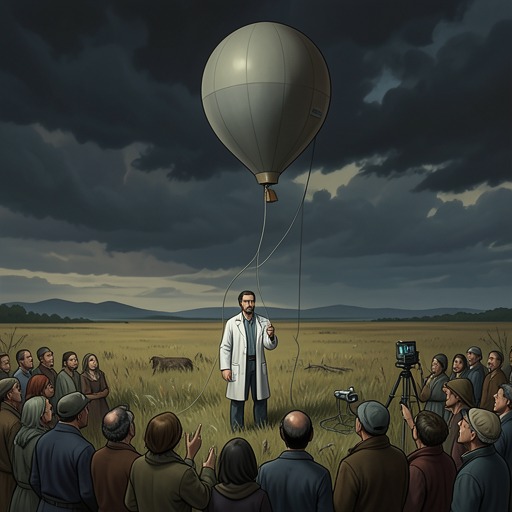
The Institute had sent a balloon over Hyderabad in the first week of November with four samplers to capture air. Three were sent to laboratories in Boston and Cardiff; the remaining sampler reached the Institute in a Toyota Innova and was examined by Oparna’s team and two American scientists. The reported fungus was therefore one component of an analysis of a particular sampler, not a result established in the supplied account by all four samples.
Public Meaning and Limits of the Claim
At the press conference, Arvind Acharya identified the two reported organisms as a rod-like bacillus and Engyodontium albus de Hoog. When a reporter asked him to spell the fungus’s name, he could not. That brief exchange made the technical name conspicuous even as the announcement framed the finding in much larger terms.
The Press Officer presented the discovery as a first step toward finding aliens and said it reopened questions about whether some suddenly appearing diseases might be extraterrestrial and whether life on Earth originally came from space. The fungus’s presence at the reported altitude gave those questions a concrete specimen around which to gather; it did not, by itself, demonstrate that the fungus came from space. Two other samplers were still being studied in Cardiff and Boston, so the announcement preceded the reported outcomes of those analyses.